Table of Contents
ToggleMost people think electric boilers are “the future” and gas boilers are “old tech.” The truth is more messy than that.
You’re choosing a heating system in a world of rising bills, changing rules, and talk of gas boiler bans. If you get it wrong, you risk years of higher costs or poor comfort.
This guide breaks down electric boiler vs gas boiler in simple terms: how they work, what they cost, how green they are, and which is best for your home.
Electric Boiler vs Gas Boiler: Full UK Comparison Guide
1. Quick Comparison Table
At-a-glance overview
| Factor | Electric Boiler | Gas Boiler |
|---|---|---|
| Fuel | Electricity | Mains gas (or LPG off-grid) |
| Typical install cost (supply + fit) | Around £3,000–£3,500 | Around £3,000–£3,500 |
| Average annual running cost (small home) | Roughly £1,600–£1,800 | Roughly £800–£1,000 |
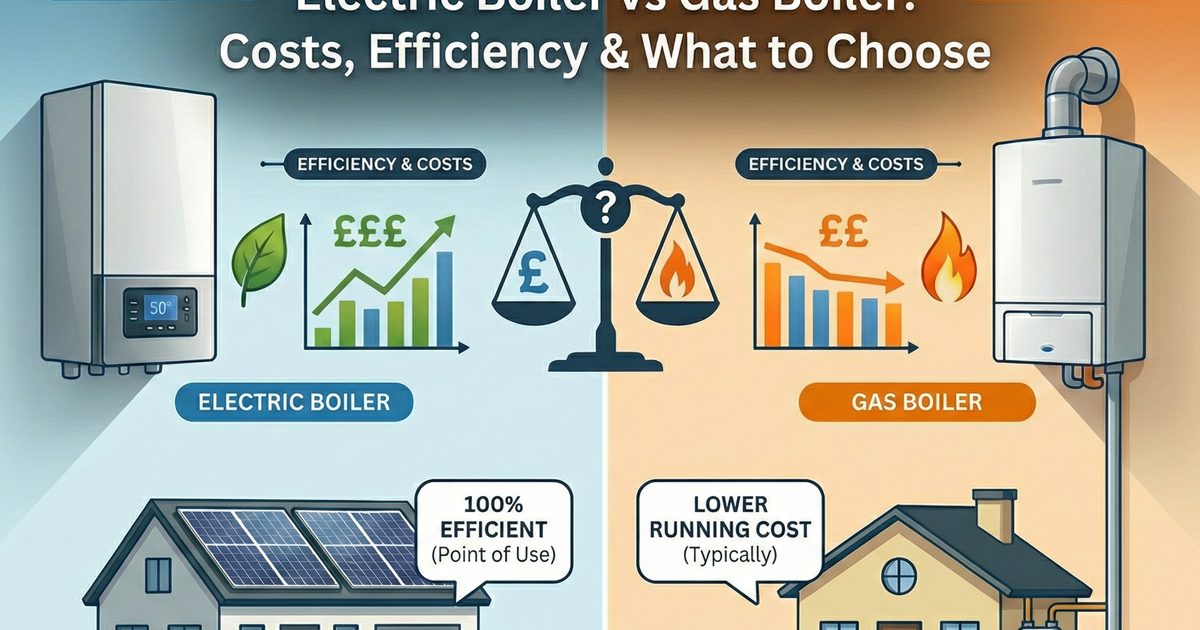
| Point-of-use efficiency | 99–100% (no flue losses) | 90–95% (modern condensing boiler) |
| Whole-system efficiency | Lower (grid generation + losses) | Higher (fuel burned on site) |
| Carbon per kWh (today's grid mix) | Can be high unless on green/solar | Lower per kWh than grid electricity |
| Best suited to | Small, well-insulated, often all-electric homes | Most UK homes, especially with higher demand |
| Servicing | Very little required | Annual Gas Safe service strongly advised |
Big picture: Electric wins on simplicity and point-of-use efficiency. Gas wins on running costs, power output, and flexibility for most homes today.
2. How Each Boiler Works (Without the Jargon)
Gas boilers
A gas boiler burns gas in a sealed chamber. The flame heats a metal “block” called a heat exchanger.
Water passes through this block, warms up, and then flows to your radiators and taps.
Modern condensing gas boilers also grab extra heat from the exhaust gases, which boosts efficiency into the 90%+ range.
You need:
- A mains gas supply (or LPG tank)
- A flue to an outside wall or roof
- A Gas Safe engineer to fit and service it
Electric boilers
An electric boiler is more like a big, clever kettle. Electric elements sit inside and heat water directly.
There’s:
- No flame
- No flue
- No fuel store
Almost all the electricity that enters the boiler turns into heat, so the unit itself is effectively 100% efficient at point of use.
But that electricity has already been made at a power station and sent across the grid, which is where some efficiency is lost.
Key idea: Gas burns fuel in your home. Electricity is made somewhere else and brought to you.
3. Cost Comparison: Purchase, Installation & Running Costs
Boiler & installation cost
For a typical UK home, the headline install cost for both types is often in the same ballpark once you include labour and materials.
| Cost element | Electric Boiler | Gas Boiler |
|---|---|---|
| Boiler unit (small–medium home) | ~£500–£3,000 | ~£600–£3,000 |
| Typical install (supply + fit) | ~£3,000–£3,500 | ~£3,000–£3,500 |
| Flue and gas pipework | Not needed | Extra materials and labour needed |
| Electrical upgrade (if required) | Can be £3,000–£8,000 for 3-phase | Not usually needed |
For most normal homes on a standard electrical supply, you won’t need a full 3-phase upgrade.
In those cases, costs for electric and gas can be very similar.
Running costs (where the gap appears)
Under recent price caps, unit rates in Great Britain have roughly looked like this:
- Electricity: around 25–30p per kWh
- Gas: around 6–8p per kWh
So for the same heat demand:
- An electric boiler might cost about twice as much to run as a high-efficiency gas boiler in a typical small-to-medium home.
- Even after adding £60–£110 per year for a gas boiler service, gas usually stays cheaper overall.
Rule of thumb:
- High heating and hot water use + normal UK tariffs → gas usually wins on cost.
- Low use + solar PV or green tariffs → electric can work well.
4. Efficiency & Environment
Point-of-use vs whole-system efficiency
On paper, electric boilers look unbeatable:
- Electric boiler: 99–100% at the boiler
- Modern gas boiler: 90–95% at the boiler
But that’s only part of the story.
For electric:
- Fuel is burned at a power station
- Some energy is lost making electricity
- More is lost in transmission across the grid
So the whole chain from fuel to hot water in your radiators is much less than 100%.
For gas:
- Fuel is delivered by pipe
- It’s burned directly in your boiler
- There are no power station losses in between
That’s why, in real-world terms, gas heating can still be more efficient overall, even though the electric boiler itself wastes almost nothing.
Carbon and “how green” each option is
Right now:
- A kWh of mains gas burned in a boiler creates CO₂ in your home.
- A kWh of grid electricity often also comes from burning gas or other fuels at a power station, plus some renewables.
So:
- Grid electricity is not automatically “zero carbon”.
- Gas is not automatically “evil”, especially when used in a modern, efficient boiler in a well-insulated home.
Where electric shines is when you:
- Use solar PV or other renewables
- Pick low-carbon tariffs
- Improve insulation so your overall demand is lower
Reframe:
The question is not “Is electric green?”
It’s “What powers your electric boiler, and how much energy do you need in the first place?”
5. Pros and Cons of Electric Boilers
Advantages of electric boilers
- Simple installation: No flue, no gas pipework, no fuel tank. Great for flats or properties that are already all-electric.
- Compact and quiet: Small wall-hung units that can fit in cupboards. Very little noise when running.
- Low maintenance: No burner, no combustion chamber, fewer moving parts. No legal requirement for a Gas Safe service (though safety checks are still wise).
- No on-site emissions: No carbon monoxide or flue gases leaving your boiler. Ideal if you’re nervous about combustion appliances.
- Potentially long lifespan: Simpler internals can mean fewer things to fail over time.
Disadvantages of electric boilers
- High running costs on standard tariffs: With electricity multiple times the price of gas per kWh, annual bills can be roughly double for the same heat use.
- Limited output for large homes: Many domestic electric boilers are around 6–15 kW. Big homes or those with 2+ bathrooms can push them very hard.
- Electrics may need checking or upgrading: A 10 kW boiler can draw around 40–45 amps. On a 100-amp main fuse, you need to think about what else is running.
- 3-phase supply for very high outputs: If you want a very powerful electric boiler, you may need 3-phase power, which is costly to install and more common in commercial settings than homes.
Best fit: Small, well-insulated, often all-electric properties with modest heat demand and possibly solar PV.
6. Pros and Cons of Gas Boilers
Advantages of gas boilers
- Lower running costs (for now): With gas far cheaper per kWh than electricity, gas boilers usually deliver the lowest bills for homes with moderate to high demand.
- Plenty of power for larger homes: Common domestic gas boilers sit in the 20–40 kW range. They can handle bigger homes and multiple bathrooms with ease.
- Fast heat delivery: Radiators and hot water heat up quickly. Ideal for older or less insulated houses.
- Mature market and lots of choice: Many brands, models and engineers to pick from. Spare parts and support are widely available.
Disadvantages of gas boilers
- On-site combustion and CO₂: Burning gas releases CO₂, which adds to your direct emissions. Less of an issue if your usage is moderate and your home is well insulated, but it still counts.
- Safety considerations: There is a risk of gas leaks or carbon monoxide if the boiler is badly fitted or serviced. You need CO alarms and regular servicing.
- Annual servicing cost: Budget £60–£110 per year for a proper service. Landlords have extra legal responsibilities.
- Policy and future uncertainty: Talk of phasing out gas in new builds and pushing low-carbon heating means gas may face more rules and nudges over time.
Best fit: Most typical UK family homes with a mains gas connection, especially where running costs matter most.
7. Which Is Best for You? Real-World Scenarios
1. Small 1-bed flat, well insulated, single bathroom
An electric boiler can make a lot of sense here:
- Heat and hot water demand is low
- Limited space for a flue or gas meter
- Electric installation is simple
- Pairing with solar PV or good off-peak tariffs improves the picture even more
Running costs will still be higher per kWh, but total use is low, so the gap in pounds per year may be manageable.
2. Typical 3-bed semi, 1–2 bathrooms, family of four
A gas combi boiler normally wins:
- Higher demand for showers and baths
- More radiators and a larger volume of water to heat
- Big difference in running costs at current prices
- Easy to find engineers, parts, and competitive quotes
You can still cut emissions by choosing a high-efficiency gas boiler, adding smart controls, and improving insulation.
3. Large or draughty house, several bathrooms
Gas almost always comes out ahead:
- You need a high kW output
- An electric boiler would run hard for long periods
- Electric running costs become very high very quickly
In this case, consider:
- High-output gas boiler
- Or, longer term, a heat pump with good insulation as part of a wider retrofit plan
4. Off-gas grid home
Your main options:
- Electric boiler
- LPG or oil boiler
- Heat pump
If it’s a small, well-insulated home and you can add solar PV, an electric boiler might be a neat, simple solution.
For bigger or older properties, an oil/LPG boiler or a properly designed heat pump system may be more practical.
5. Eco-focused homeowner
You effectively have two broad paths:
- Path A: Electric boiler + renewables: Use solar PV, batteries and/or green tariffs to cut the true carbon cost of your electricity.
- Path B: Ultra-efficient gas as a transition: Replace a very old boiler with a modern, A-rated gas boiler, lower demand with insulation and controls, and plan a move to low-carbon tech later.
8. Decision Checklist: Electric or Gas?
Use this simple checklist to make your short-list:
Do you have mains gas?
- Yes → Gas is usually cheaper to run.
- No → Compare electric, LPG/oil, and heat pumps.
How big is your home and demand?
- 1 bed, 1 bathroom → Electric can work well.
- 3+ beds, 2+ bathrooms → Gas usually more practical.
What’s your top priority?
- Lowest bills → Gas.
- Simpler system, no flue → Electric.
- Lowest long-term carbon → Electric + renewables or heat pump.
Can your electrics cope?
- Check main fuse rating and spare capacity before choosing a high-kW electric boiler.
How long will you stay in the property?
- Short to medium term → A sensibly sized gas boiler often gives best value.
- Long term with plans for solar/retrofit → Electric or hybrid strategies can make more sense.
9. FAQs – Electric Boiler vs Gas Boiler
Yes, in most UK homes today. Gas is much cheaper per kWh than electricity, so for the same heat demand, a gas boiler usually costs around half as much to run.
They are close to 100% at the boiler, because almost all the electricity becomes heat. But once you factor in how that electricity is made and moved, the true “fuel to heat” efficiency is lower.
They don’t have the same legal servicing rules as gas boilers. However, basic safety and performance checks every few years are still wise, especially to protect warranties and spot any issues early.
Gas boilers in existing homes are not being ripped out. Changes are more likely to affect new builds and push households towards lower-carbon options over time. Still, it’s smart to think ahead and improve insulation whatever system you choose.
Yes, but plan ahead:
- Check your electrical capacity now
- Improve insulation so future running costs are lower
- Design your system so changing heat sources later is easier (pipework, cylinder, controls)
10. Electric Boiler vs Gas Boiler
- Electric boilers are simple, compact, and clean at the point of use. They suit smaller, well-insulated, often all-electric homes – especially with solar PV or green tariffs.
- Gas boilers remain the most cost-effective choice for most UK homes with mains gas, especially where heat and hot-water demand are higher.
Instead of asking, “Which is best in general?”, ask: “Which boiler makes the most sense for my home, my bills, and my long-term plan?”
If you tell us:
- How many bedrooms and bathrooms you have
- Rough insulation level (old leaky vs modern well-sealed)
- Whether you have gas, solar, or neither
…We can help you design a tailored boiler strategy with sizes, rough running costs, and upgrade steps for your specific property.

With many years on the tools in all aspects of the engineering industry has given me a second to none skill set which enables me to provide a leading professional service to my customers with a wealth of knowledge and highly skilled engineers to successfully cover all your plumbing, heating, AC and catering equipment requirements.