There are few household sights as unwelcome as a flashing red light on the boiler, especially when the temperature outside is dropping. It’s a scenario that can cause immediate concern, bringing with it visions of cold showers and a chilly house. A boiler breakdown can be a miserable ordeal, but that blinking light doesn’t always signal a major disaster or an expensive repair bill.
While it’s a critical indicator that your boiler has a fault and requires attention, many common issues can be diagnosed and sometimes safely resolved without needing to call an engineer. This guide will walk you through the most common reasons for a boiler fault, explaining which problems you might be able to fix yourself and, crucially, when it’s essential to stop and call a professional.
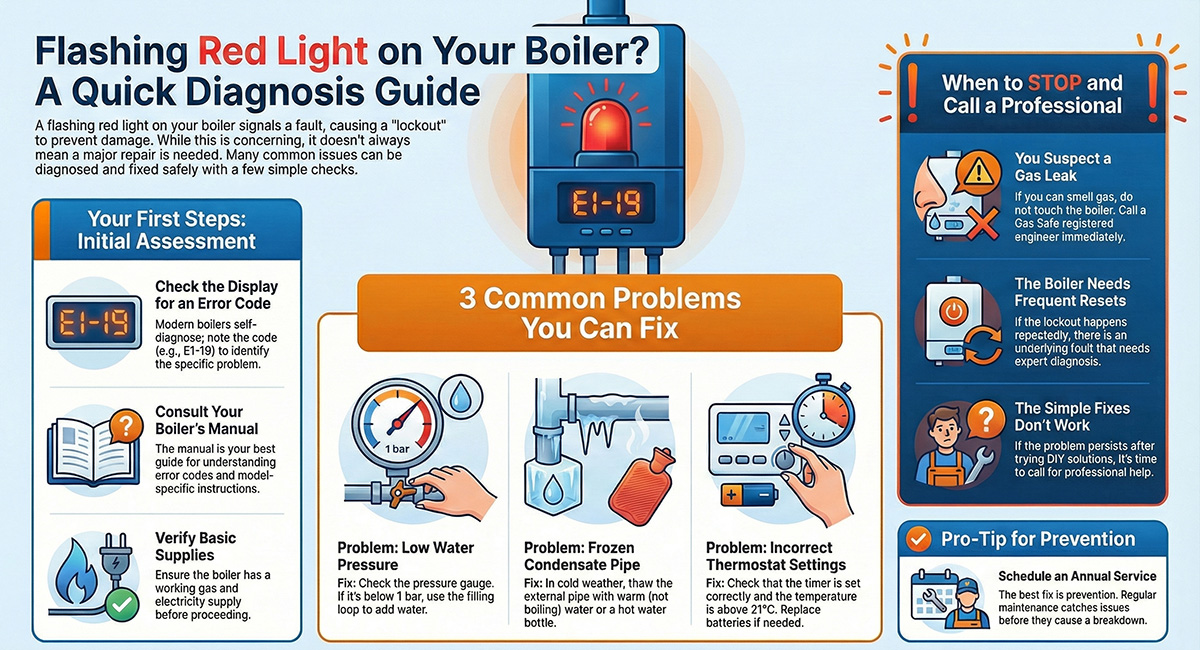
First, Don’t Panic: Your Initial Assessment
Before attempting any fixes, a calm and methodical assessment is the best first step.
- Consult the Manual: Your boiler’s manufacturer manual is the most valuable resource you have. It will provide specific information on what different flashing lights and error codes mean for your particular model, along with troubleshooting steps.
- Check the Display: Look at the boiler’s digital display. Modern boilers will often show a specific fault or error code, which is the boiler’s way of self-diagnosing the problem. These codes often start with an ‘E’ or ‘F’. For example, if you see ‘E1′ and ’19’ displayed immediately after one another, this is the boiler signalling a low system pressure fault (E1-19). This code is the key to understanding the exact nature of the problem.
- Verify Basic Supplies: Ensure your boiler has a functioning gas and electricity supply. If the digital display is lit, you can be sure that it is receiving electricity.
Five Common Boiler Faults (And How to Fix Them)
A flashing red light often indicates one of several common problems. When a modern boiler detects a fault, its built-in safety features will shut the system down to prevent damage or unsafe operation. This is known as a ‘boiler lockout‘, and it’s the reason you see that warning light. Thankfully, many of these issues can be resolved without calling an engineer.
Low Water Pressure
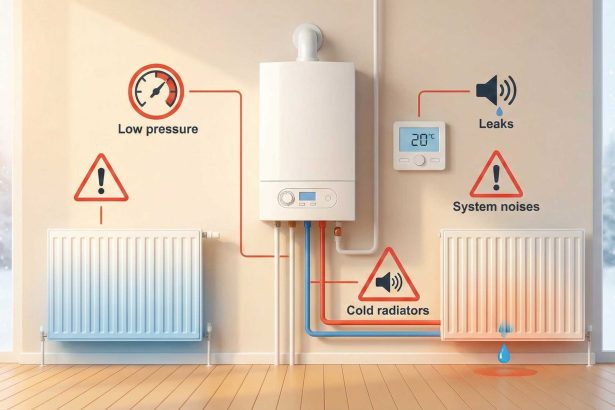
Low water pressure is one of the most common reasons for a boiler to lock out. The system needs the pressure to be within a specific range to operate safely.
Symptoms:
- The boiler switches itself off.
- The central heating makes banging sounds.
- Radiators furthest from the boiler are not heating up.
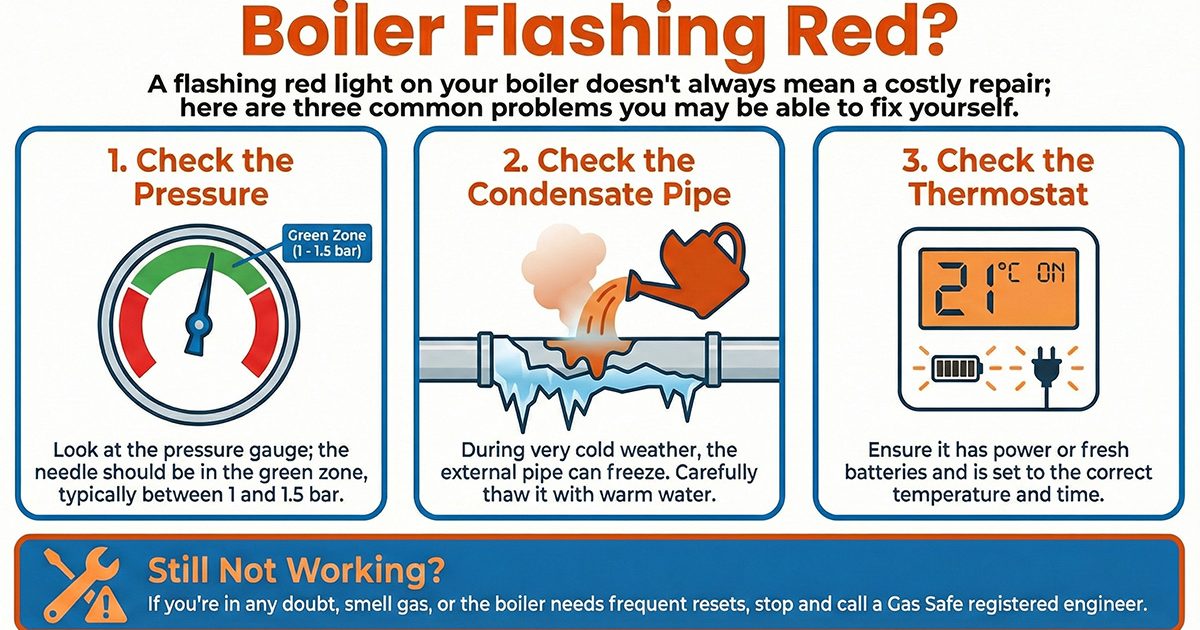
The Fix: Check the pressure gauge on the front of your boiler. The needle should typically be between 1 and 1.5 bar. If it has dropped below 1 bar, you can carefully increase the pressure using the boiler’s filling loop (a flexible pipe, usually underneath the boiler). You may need to reset the boiler after doing this.
The Caveat: If your boiler pressure keeps dropping, it may indicate a leak somewhere in the heating system. This requires a professional Gas Safe engineer to investigate and repair.
A Frozen Condensate Pipe
During very cold weather, the condensate pipe, which carries condensation from the boiler to an outside drain, can freeze. This creates a blockage and stops the boiler from working.
Symptoms:
- Gurgling sounds are coming from the boiler.
- The boiler won’t fire up.
- The outside temperature is very low.
The Fix: This issue has a simple DIY solution. Carefully thaw the pipe by applying hot (but not boiling) water or using a warm compress, like a hot water bottle, directly on the frozen section of the pipe.
Thermostat and Settings Issues
Sometimes the issue isn’t with the boiler at all, but with the controls that tell it what to do. This can be common after a power cut, which can reset timers and settings.
Symptoms:
- The boiler doesn’t come on when it should, or comes on erratically.
- An error message or a blank panel is showing on the thermostat.
The Fix:
- Double-check the timer settings on the boiler’s control panel.
- Ensure the central heating dial on the boiler itself is turned up.
- Check the thermostat’s temperature setting; the boiler may not fire up if it’s set below 21℃.
- If the thermostat’s display is blank, it may simply need new batteries.
The Pilot Light Has Gone Out
The pilot light is a small, continuous flame that ignites the main burner when your heating or hot water is needed. If this flame goes out, the boiler won’t work.
The Fix: In most cases, you can reignite the pilot light by following the specific instructions in your boiler’s manual.
A Fault That Needs a Simple Reset
Sometimes, after you’ve fixed the underlying problem (like repressurising the system), the boiler needs a final reset to clear the fault and get working again.
The Fix:
- Locate the reset button on the boiler’s front panel. It is often marked with a flame symbol, a cross, or the word ‘RESET’.
- Press and hold the button for up to 10 seconds (check your manual, as some models require as little as 3 seconds) and release it only once.
- Wait a few minutes for the boiler to complete its startup cycle. A successful reset is often indicated by the flashing light turning to a steady green, the error code disappearing from the display, or a ‘burner’ light turning on.
The exact method can vary by manufacturer, so always check your manual, but here are a few common examples:
- Worcester Bosch: Many models require you to press and hold the reset button for 3 seconds. However, some older models have a reset position on the temperature dial instead of a button.
- Vaillant: Most Vaillant boilers, like the ecoTEC, have a dedicated reset button that you should press and hold for just one second.
The Caveat: Do not press the reset button repeatedly, as this can damage the boiler’s control panel. If the boiler keeps going into lockout and needs to be reset frequently, there is an underlying fault that needs to be diagnosed by a professional.
While these DIY fixes can resolve many common issues, it’s crucial to recognise when a problem is beyond your scope and requires professional intervention.
When to Stop and Call a Gas Safe Registered Engineer
DIY fixes are only appropriate for the most minor and common issues. For your safety and to prevent causing further damage, a qualified professional is necessary for almost all other problems.
“Attempting to fix complex boiler problems without the necessary expertise can be dangerous and may result in further damage to the system.”
It is time to stop and call an expert if:
- You are in any doubt about what to do.
- Your boiler needs to be reset frequently.
- You suspect a gas leak (you can smell gas).
- The boiler is making unusual noises like droning or whooshing.
- You have tried the simple fixes outlined above and the boiler still won’t work.
For any repairs or servicing, it is crucial that you only use a Gas Safe registered engineer. This ensures the work is carried out correctly and safely.
The Best Fix: Prevention Through Annual Servicing
The best way to ensure your boiler operates efficiently and to minimise the likelihood of unexpected breakdowns is through preventative maintenance. Consider scheduling an annual service with a reputable heating engineer. A regular check-up will identify and address potential issues, like worn-out components or dropping pressure, before they escalate into a fault that causes a full lockout.
Red Light Flashing on Boiler? A Well-Maintained Boiler is a Reliable Boiler
A flashing red light on your boiler is a clear warning that it needs attention. However, by calmly assessing the situation and checking the manual, a homeowner can often identify and sometimes fix simple faults like low pressure or a frozen condensate pipe. Knowing how to perform a basic reset can get your heating back on quickly once the initial problem is solved.
Ultimately, understanding these common issues empowers you to handle minor hiccups while recognising the critical signs that mean it’s time to call a professional. Now that you understand the common culprits, what one simple check – like glancing at the pressure gauge once a month – could you add to your home routine to prevent a future boiler breakdown?

With many years on the tools in all aspects of the engineering industry has given me a second to none skill set which enables me to provide a leading professional service to my customers with a wealth of knowledge and highly skilled engineers to successfully cover all your plumbing, heating, AC and catering equipment requirements.